



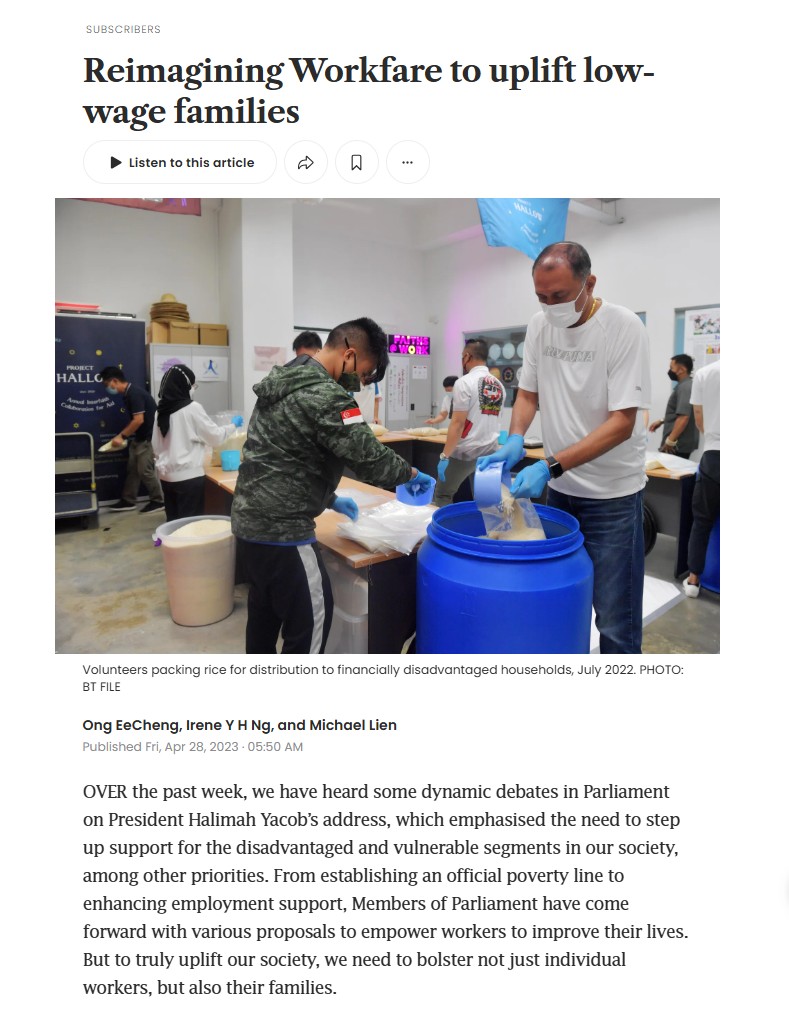
The Business Times: Reimagining Workfare to uplift low-wage families
Singapore, 28 April 2023 – Over the past week, we have heard some dynamic debates in Parliament on President Halimah Yacob’s Address, which emphasised the need to step up support for the disadvantaged and vulnerable segments in our society, among other priorities. From establishing an official poverty line to enhancing employment support, MPs have come forward with various proposals to empower workers to improve their lives. But to truly uplift our society, we need to bolster not just individual workers, but also their families.
The answer to this may come from the reimagination of a familiar policy — the Workfare Income Supplement (WIS).
Reimagining a household-based WIS
WIS was introduced in 2007 to incentivise regular work and support the expenditure needs and retirement savings of older lower-wage workers and persons with disabilities. WIS in its current form considers only the worker’s age, employment status (employee or self-employed), and income when determining the disbursement amount.
However, workers are responsible not only for themselves, but also for their dependents. When asked, “Why do you work?”, many will say, “To provide for my family.” Workers who are raising young children, supporting elderly parents or grandparents, or caring for disabled family members face far greater financial burdens than those with no dependents.
To create a stronger and fairer Singapore, we reimagine a WIS that accounts for the size and needs of the worker’s household, similar to the Earned Income Tax Credit (EITC) in other countries such as the U.S. and South Korea.
The EITC is a tax credit based on household income and the number of dependents. If the tax credit exceeds the tax owed, then the household receives a check from the government — akin to a negative income tax. By providing earnings supplements to low-wage earners, WIS is similar to the EITC, except that WIS is given to individuals.
Valuing unpaid household work
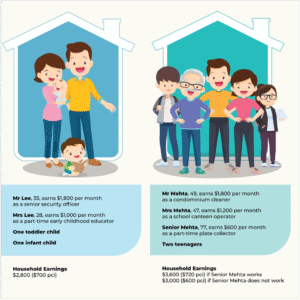
Relative to the current individual-based WIS, a household-based WIS will better support households with young children or the elderly, as illustrated in Figure 1.
A household-based WIS recognises the value of unpaid caregiving and housework, which may include caring for children, the elderly, or disabled family members as well as chores such as cooking, cleaning, and laundry. Here we use the replacement cost approach, which assumes that an hour of unpaid household work would be as valuable as the price of the same hour of household work outsourced to paid household service providers. The value of time spent on unpaid household work is estimated to be around 15 percent of GDP, roughly equal to the average value added by the manufacturing sector in the OECD.
For example, a household-based WIS gives Mrs Lee (in Figure 1) the option to work fewer hours or to temporarily opt out of the labour force to care for her children when they are young. Similarly, Senior Mehta has the option to stop working when he becomes frail.
Empowering workers to invest in their future and their children’s future
Increasing the quantum for workers with dependents will empower workers to invest in their future and their children’s future. Beyond living expenses and retirement needs, a long-term focus entails saving to weather negative shocks. Having a buffer could also enable workers to take time off work to upskill and advance to a higher-paying job.
Researchers have found that higher payouts in the U.S.’s Earned Income Tax Credit (EITC) in childhood have positive effects on educational attainment and employment outcomes in adulthood, in turn mitigating income inequality and enhancing intergenerational mobility. Such schemes are especially important given that rising income inequality has resulted in widening class gaps in parental financial investments in children. For instance, in the last Household Expenditure Survey in 2017/18, Singaporean households in the top quintile spend a monthly average of $167 on tuition and enrichment classes — almost four times as much as the $45.30 spent by the bottom quintile. A WIS that adjusts for household size gives parents a little extra to make such investments in their children.
Incentivising work
A household-based WIS is also expected to maintain work incentives.
As the WIS quantum increased through the years, the work incentives embedded in the current design have weakened. Consider a 40-year-old worker, Loong, who earns $500 a month. He receives a WIS payout of $89. For every additional $100 he earns — up to $1,400 — the WIS payout rises by $18. This is the phase-in rate, which is 18%.
If Loong’s earnings increase to between $1,400 and $2,000 a month, he will receive the maximum WIS payout of $250. However, for every additional $100 he earns beyond $2,000, the WIS payout falls by $31. This is the phase-out rate, which is 31%. The sharp reduction in the WIS payout may disincentivise Loong from working more hours.
The change to a household-based WIS is an opportunity to increase the phase-in rate, thus incentivising entry into work, and to decrease the phase-out rate, thus minimising disincentives to work more hours.
At the same time, transitioning WIS to a household-based approach may also induce the second worker in some households to switch from paid employment to unpaid caregiving and housework. However, WIS payouts are expected to be modest and substantially below earnings. Consequently, only individuals with high care needs at home, such as Mrs Lee, or individuals who find work increasingly challenging, such as Senior Mehta as he gets frail, will find it worthwhile to opt out of paid employment.
Pivoting to counter new challenges
The external environment has become more challenging due to persistent high inflation and an impending global recession, combined with ongoing disruptions caused by automation and climate change. Furthermore, an ageing population implies that working adults are supporting more dependents. Hence, it is timely and apposite for WIS to be tailored to household needs and not just individual needs.
While the implementation of a household-based WIS will require some form of filing by households, the process can be kept simple with pre-filled information — something that is possible today with the advancement of analytics technology that was not available 16 years ago when WIS was first introduced.
As the world is transforming, so must we. We present a reimagination of a policy that can adapt to the challenges of the future — a future characterised by an environment that has changed substantially since the initial conception of WIS.
Ong EeCheng is a senior lecturer at the Department of Economics at the National University of Singapore (NUS). Irene Y. H. Ng is an associate professor at the Department of Social Work, NUS. Both EeCheng and Irene are affiliated with the Social Service Research Centre (SSR), NUS. Michael Lien is the founder and board chairman of LEAP201, a venture philanthropy organisation.
This article summarises one of the recommendations in a report on a reimagined WIS, commissioned by LEAP201 and written by SSR.
Link to Business Times article: https://www.businesstimes.com.sg/opinion-features/reimagining-workfare-uplift-low-wage-families