



Budget 2024: Workfare enhancements announced at Budget 2024 equate to Bigger Payouts, for More Low-Income Workers
Increasing the cash portion and accounting for inflation and the household size can provide more financial stability.
Executive Summary (520 words, 2 min)
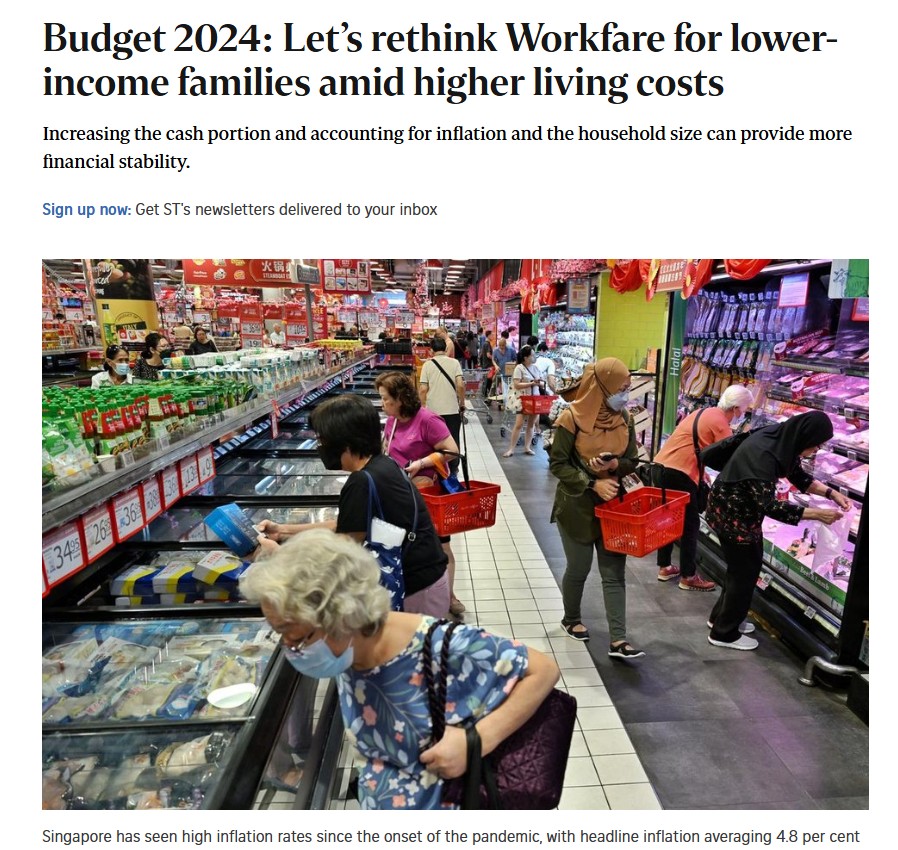
Singapore, 5 Feb 2024 – The Covid-19 pandemic has resulted in consecutive years of substantial price increases in Singapore, making cost of living one of the most pressing issues to be addressed in our society. Lower-income families are affected more.
The Workfare Income Supplement (WIS) scheme targets Singaporean workers whose incomes are in the bottom 20 percent, and can be the centerpiece of a regular support package for lower-wage workers.
Together with the National University of Singapore’s Social Service Research Centre, I made the case for a series of WIS enhancements in April 2023, including reviewing the scheme yearly to adjust for inflation. Budget 2024 could provide the impetus for a significant adjustment to the Workfare quantum, and also a rethinking of the various features of this scheme.
Revisiting a familiar policy that supports lower-income workers
The Workfare Income Supplement (WIS) scheme has been a lifeline to the lower-income workers to tide over their living expenses. Despite numerous enhancements since its introduction in 2007, the fact that it is still disbursed at the individual level means that it will not fully account for the far greater financial burdens that these workers face.
As Singapore develops a refreshed social contract in the coming years through the Forward Singapore initiatives, it is worth reimagining the WIS scheme to further strengthen support for lower-income workers and their families.
3 proposals for a reimagined Workfare
First, we can explore indexing WIS to inflation or reviewing it annually. Given that economic conditions are inherently unpredictable, it is necessary to review support schemes like WIS annually and develop a framework for adjusting the annual quantum.
Second, there can be an increase in the proportion of WIS payouts allocated to cash can help households meet their immediate needs. Higher inflation has resulted in costs of basic necessities such as groceries and transportation escalating over the past few years.
Allocating a larger proportion of WIS payouts to the cash portion also provides a stronger work incentive due to present preference, where a dollar received today generates greater utility than a dollar received in the future.
Lastly, the WIS can be reimagined to account for the size and needs of the worker’s household, similar to the Earned Income Tax Credit (EITC) in other countries such as the U.S. and South Korea.
Based on our research, we calculate that a lower-income household comprising a married couple with one breadwinner and two young children could get an additional $100 per month in a household-based WIS, compared to the current WIS.
A fairer and stronger society
The WIS has been very effective and has wide reach because assessment of eligibility and disbursement is automatic based on CPF contributions from the employer. As our workers face an uphill battle against globalisation, rapid technology changes, economic uncertainties and an aging population, reimagining the WIS is all the more critical not just for the individuals, but also for their families.
More than ever, the whole of society – government, businesses, NGOs and the public – need to join hands in a collective effort to build a fairer and stronger society, where lower-income workers and their households are not left behind.
This Op-Ed was covered by The Straits Times (5 Feb 2024), link to the full Op-Ed: https://www.straitstimes.com/opinion/budget-2024-let-s-rethink-workfare-for-lower-income-families-amid-higher-living-costs